June Godaddy Domain and Hosting Coupons

These June coupons are coming to an end. Just one week left. Here are the best ones:

99COMS .99 cent .COM Domains (one new domain or transfer domain at this price then just $9.99 for additional domains)
==> direct link here

35off 35% Off Your Entire Order
==> direct link here

You can always find a list of the godaddy source codes here

Nominet Overhauls Its Procedures


Nominet, a popular registrar of .co.uk domain names, recently outlined a comprehensive set of changes to its services, which it will implement beginning in May of 2012. The biggest change is that a single-year registration of a .uk domain name will cost £3.50 per year, where a two-year registration will be £2.50 per year. Both prices will have the standard VAT added atop those prices. The two-year price is the same as before, but the availability of one-year domain purchase is a new element to Nominet’s services.

Domains will also be available for renewal for up to 10 years, and renewal will be possible at any time, as long as the renewal years do not add up to over 10 years. Prior to these changes, registrants could only acquire Nominet domains in two-year blocks.  There are other new aspects to Nominet’s operating procedures, too, many of which seem to streamline customer services, billing, and renewal processes. One of these changes includes an inability to cancel a purchase once the registration invoice has been issued to the customer.
Apparently, there had been concern that the availability of single-year domain registration would increase the number of non-serious domain customers – people who want abusive or throwaway domains in the .uk registry. Hopefully, a slightly higher cost for a one-year period of registration will set this problem back slightly.

Domain Registrars Protest SOPA/PIPA

On January 18, 2012, several websites, including domain name sites, went dark to protest the proposed legislation restricting the use of copyrighted material on the internet. This legislation, in the form of two linked bills, the Stop Online Piracy Act (SOPA) and the Protect Intellectual Property Act (PIPA), was moving through Congress at an accelerated pace thanks to the support of numerous media conglomerates such as the Motion Picture Association of America (MPAA) and AOL/Time Warner.

Websites such as Wikipedia and Reddit shut down for 24 hours, beginning at midnight on the 18th, to protest the bills and spread awareness to areas of the nation that might not be aware of them. Google, while it didn’t end any functionality, had a blacked-out version of its logo and a link on its homepage requesting protest by citizens to their congressional representatives. Some were upset with those companies that are very involved with online content such as Go Daddy. However they have great customer loyalty with their godaddy promo coupon and other features to keep prices low.

Many large and small sites joined in the protest. These bills represent a cause that matters to virtually the entire internet community. GoDaddy, one of the supporters of the bill, lost an enormous number of subscribers due to its pro-SOPA stance (which it later reversed). Additionally, domain name registrars NameCheap.com, Name.com, and Hover.com joined in the protest, showing that it wasn’t just sites that rely on user-submitted content to find the legislation ill-intentioned.

SOPA has been stalled indefinitely due to the outcry. Many of the bill’s congressional sponsors have backed down their support.

DOMAINfest Global Fantasy Domaining Contest

Each year, Oversee.net hosts an event in Los Angeles called DOMAINfest Global. It has expanded through the years to include just about anyone who has an interest or investment in domain names and “domaining”, and in 2012 the event will host a contest with a terrific prize.

The Fantasy Domaining Contest will run a little like a fantasy football tournament. The big winner will receive a trip to the 2012 DOMAINfest Global conference, including a $1,000 travel stipend and four nights at a hotel in addition to free tickets to the conference and a publicly-awarded trophy. The second-place and third-place winners will get free and half-off tickets to the conference, respectively.

The contest will help hone the skill of its contestants at the domain name game. From a list of 1,000 domains, the entrants to the contest will draft a roster, put domains “in-play”, substitute and trade domains with other users, and project PPC revenue. From an original list of 35 selected from the 1,000, 25 domains are put into play. The contestant must choose the domains that s/he thinks produced the most PPC revenue between December 1, 2010 and January 16, 2011, and the actual revenue recorded for the domains between those dates determines the contestant’s overall ranking based on his or her roster.

The contest began on December 1, 2011, but you can still sign up and play (if you’re a resident of the United States) through January 16, 2012. Signing up is free. Winners will be notified on January 18, 2012. For more details, visit http://www.domainfest.com/fantasy. You can always get a domain of your choice here http://godaddy-coupons.longest.com/the-best-godaddy-coupons/.

German Company Sues Facebook Over Page Name

Domain name squabbles aren’t just restricted to .coms, it seems. A German pharmaceutical company doing business as Merck evidently entered into an agreement with Facebook in March of last year to hold rights to the page at www.facebook.com/merck. However, the U.S. company doing business as Merck is now “squatting” on that page, and the German Merck has filed suit in New York to get its Facebook page back.

Interestingly enough, the two companies were separated as part of German reparations after World War I. They are not affiliated with each other and are, in fact, competitors. (Who knew a Facebook war could have its origins in 1918?)

This dispute raises the question as to whether regulatory efforts regarding domain names can be translated to other styles of websites. The German Merck’s lawyers argue that the Facebook page is of great marketing value, and that because Facebook does not differentiate internationally in the same way that .coms don’t, the German Merck’s rights to this property of value have been co-opted.

Merck is not suing the U.S. Merck, however; it is suing Facebook only at this time, because Facebook has refused to hand over documents and information that Merck finds necessary to determine how the U.S. Merck obtained access to the facebook.com/merck page. The suit also claims that Facebook was unresponsive and evasive to the German Merck when the company tried to resolve the matter, and hints at further action if nothing is done to restore the Facebook page to the German company.

The suit was filed on the Monday before Thanksgiving. Time will tell whether the page will be returned to the right Merck.

.xxx for Colleges

.xxx became available to trademark owners on September 7, 2011, and will become widely available to general domain name buyers on December 6th. In the meantime, an unlikely group of buyers has been snapping up the domain names ending in .xxx – colleges and universities.

No, Harvard isn’t going into the pornography business. But if a domain name buyer picks up harvard.xxx before Harvard does, you can bet that site would make an awful lot of money. Harvard wants to avoid its name being smeared in this way (and someone else profiting off the Harvard name, more likely than not). When getting a domain try a network solutions coupon for a discount. Colleges and universities are buying the domain names to keep them safe, to keep them from being utilized by pornographers hoping to capitalize on fantasies about Harvard girls on a site that ends in .xxx.

.xxx domains are currently selling for about $200 apiece, and multiple domains are being purchased by some schools of higher learning. Let’s hope the Board of Trustees never finds out about such an expenditure – or that they get a quick explanation.

.xxx reportedly raked in about $10 million from domain name buyers just during its sunrise period, which expired on October 29. Currently, .xxx is in landrush, and apparently pricing and information have been difficult to find for those in the business of domain name purchase. December 6th will certainly be a big day.

Should You Worry About UDRP?

The Uniform Domain-Name Dispute-Resolution Policy (UDRP) is a policy established by the Internet Corporation for Assigned Names and Numbers (ICANN) to put some order to disputes between people who have purchased certain domain names and people who want the rights to those domain names without paying exorbitant prices for them. For example, the Trump Organization has recently filed UDRP proceedings so as to try and get the owner of TrumpWine.com and TrumpWines.com to hand over ownership of those domain names to The Donald. (Trump has only recently gotten into the business of wines.)

In order for a UDRP complaint to succeed, the complainant must establish three elements:

  1. The complainant has rights to a trademark or a service mark which is identical, or similar enough to be confused with, the domain name.
  2. The person who owns the domain name does not have any rights or any real interest in it.
  3. The person who owns the domain name is using it in “bad faith”.

“Bad faith” can have a complex set of meanings in legalese, and the panel adjudging the UDRP complaint will use a variety of factors to assess whether the use is in bad faith or not. But since a lot of people buy domain names that they hope to sell back at a profit when those names become useful to others, UDRP can be a real concern for people who traffic in domain names.

Unfortunately, the UDRP is weighted somewhat in favor of the person who owns the trademark, not the person who owns the domain name – basically, Trump is likely to win this round. Further legislation is almost certainly coming in the future, but for right now, you’ll walk a thin line in buying a domain name that’s similar to a well-known trademark or service mark.

What’s in a CNAME?

As described in RFC 1034 and detailed in RFC 1035 back in 1987, a CNAME, or Canonical Name, DNS resource record is an alias for a host.  By example, let’s take a look at a fictitious host (sigma) in a fictitious domain (example.com) with the following A (address) record:

sigma.example.com      IN   A                     192.168.1.100

This would make sigma.example.com resolve to an IP address of 192.168.1.100.  We could use a CNAME record to make an alias for sigma.example.com:

www.example.com        IN  CNAME          sigma.example.com

A DNS query for sigma.example.com or www.example.com would return both the CNAME and Address resource records.  All modern web browsers would then use the Address resource record to connect to the site.  This enables a single physical host machine or server to mimic multiple individual servers, without the typical user knowing that the web server that their browser connects to is a shared resource.

Using our fictitious host, sigma.example.com, and our fictitious CNAME or alias, www.example.com, we could include the following in our Apache 2.x configuration:

NameVirtualHost *:80

<VirtualHost *:80>

DocumentRoot                 /server/www

ServerName                      www.example.com

</VirtualHost>

<VirtualHost *:80>

DocumentRoot                 /server/sigma

ServerName                      sigma.example.com

</VirtualHost>

Our configuration would allow the single real host, sigma.example.com, to serve web pages for both sigma.example.com and www.example.com.

MX records are our friends!

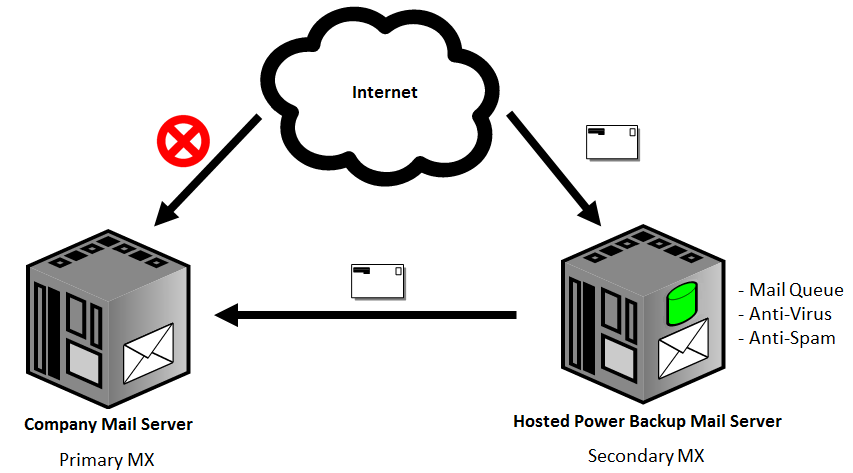
MX records have been around since they were introduced in Internet Request For Comments (RFC) 973 in January of 1986, replacing two other DNS record types, MD (Mail Delivery) and MF (Mail Forwarding).  MX stands for “mail exchanger” and simply put, establishes alternate hosts, which can be used for delivering mail to a domain.  MX records have two components, a numeric preference and a host name.  The host name itself must have an A (address) record.

Typically another mail server, which has received an email for a domain that it doesn’t know how to directly deliver, queries DNS for a list of MX records that match the domain of the To: address in the email. It looks for the lowest preference number and contacts that mail server via SMTP.  If there are two MX records with the same preference number, any of them that share the lowest number may be used.  If mail delivery is not successful with the first host, the host with the second lowest preference number is used for the next attempt at mail delivery, typically after a timeout.

All of this provides a level of redundancy and backup to ensure emails can be successfully delivered, even if one or more mail servers are inaccessible.

Guide to Network Solutions

The term “one stop shop” is rarely utilized properly. However I would venture to say that in the example of getting and promoting a new online business it may apply here. You can get online, obtain a website as well as a mobile website, and marketing all from one provider. Follow this link to obtain a discount at Network Solutions and take a look at all they have to offer.

Network Solutions has been around longer than any other domain registrar. However that is just one of the many services they provide. You can create a website and have it marketed. As the first domain registrar it is a good bet they know what they are doing.

Network Solutions Products and Services
We created a twenty page guide to cover the products and services that they offer. Start here and use the right hand side list of pages to learn more. See the Network Solutions Guide.